|
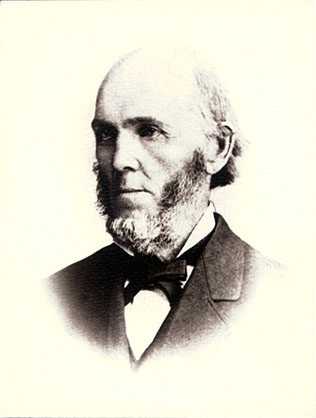
JOHN SARGENT DIXON John S. Dixon was born August 24, 1818, in Mexico, Oswego County, New York. His early life was uneventful, and as a young man he taught school. It was while teaching in Ohio that he met and married Phoebe S. Pratt. The wedding took place in Orwell, Ashtabula County, Ohio, on July 1 1846. Sometime later he moved his family to Michigan, where he taught school until 1854. That year he bought 212 acres of land from Charles P. Bush. It included a large part of the north side and much of the valley of what was later to become the city of Charlevoix. As soon as the school term was out in the early summer of 1854 the Dixon family moved from Lansing to Old Mission, where they spent the winter. On May 11, 1855, Mr. Dixon and his family disembarked from the little schooner "Emeline" at the mouth of the Pine River. As the chartered "Emeline" headed back toward Old Mission, the little group, which consisted of the Dixons and their three children, a Mr. Wolcott, a hopeful business partner, and Frank Mays, a hired hand, prepared to face what was to prove to be a most hostile environment. Mr. Dixon surveyed his holdings immediately on landing from the "Emeline." He found several deserted fishermen's shanties, one of which was in a livable condition. It stood on the north side of the mouth of the Pine River, a short distance from Round Lake. This, then, would be his residence. He was well aware of the small Mormon settlement in the vicinity. They appeared to ignore him, but they were hostile. It is not surpeosing that in this northern wolderness a people of one faith who had had trouble with the so-called Gentiles before, should look on any newcomers with a great distrust. All of their suspicions centered on Mr. Dixon and they told him he was unwelcome simply by demolishing the shanty he had intended using for his home. Since Mr. Dixon's first thought was a shelter for his party he ignored the action of the Mormons and proceeded to build a temporary abode on the beach from lumber he had brought from Old Mission. The next few days were spent clearing a path along the south margin of the stream. Having brought a considerable amount of supplies, including a small boat and a team of oxen, they had ample means for the job. By towing the small boat, with the aid of the oxen, both the family and goods were transported up the river, which was forded at a shallow point, and safely landed on the north shore of Round Lake. Undaunted by the actions of the unfriendly Mormons the men soon had the wrecked shanty rebuilt. In no time, land was cleared for a vegetable garden and the garden planted, the felled trees made into firewood, and tasks too numerous to mention kept these hardy pioneers busy from dawn to dusk. In July, 1855, a party of about fifty Mormons, led by King Strang, assembled at Holy Island, in the south arm of Pine Lake, for what they termed "a feast of first fruits." When they returned the next day they had several long timbers in tow. From these they erected a gallows on an elevation near the mouth of the River. After the Mormons had sailed for Beaver Island the gallows was inspected by the Dixon party. It was found to have four roughly carved images of men hanging by the neck, and another standing erect on the frame. On one of them was the figure of a coffin, and on it, drawn with red chalk, was this inscription: (continued on next page) |