|
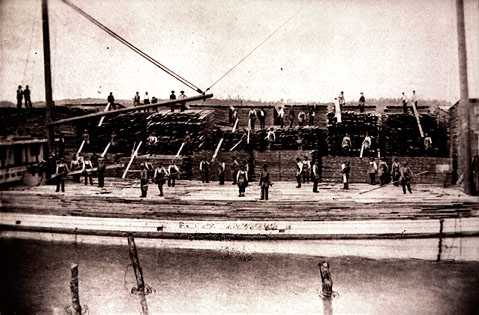
LOADING THE "THREE BROTHERS" Fifty-five men loading the "THREE BROTHERS" with lumber at Boyne City, 1905. The ship was named after the White Brothers, pioneer business men and lumber kings of Boyne City.
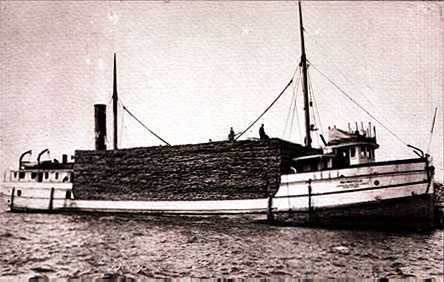
THREE BROTHERS The "THREE BROTHERS," largest ship of the Wm. H. White & Co. fleet of Boyne City, carried hardwood and hemlock to lumber hungry ports far and wide. The White Brothers made a deep impression in business circles of Boyne City and Charlevoix County. Above, the "THREE BROTHERS" loaded to her letter (referring to "W" on her stack).
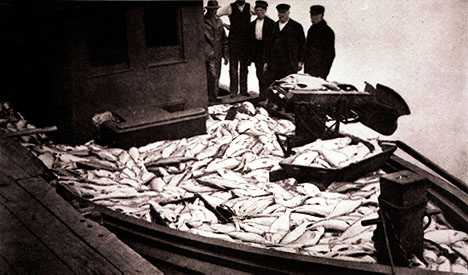
A LIFT OF TROUT By 1905 the romantic era of the sailing schooners was drawing to a close. The tugs that had been engaged in the towing of these ships through the channels and in and out of the harbor were now at the crossroads, pressed for something to do to keep them from bankruptcy. Some did go out of business, but many turned to the wide open fishing industry, which proved to be as lucrative as the towing had been. Some of the lifts were so great and the fish piled so deep on the deck that many a still live fish would flop over the rail to its freedom. The above picture shows a normal lift on the deck of the tug "PARMELEE."
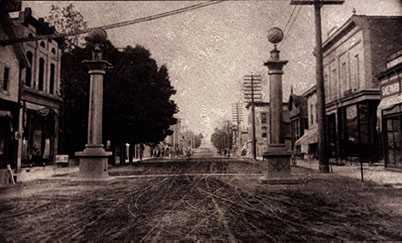
BRIDGE STREET, 1906 The building on the far left was the Crouter Drug Store. The upper floor housed Charlevoix's first telephone exchange. Next door was the Sugar Bowl, owned and operated by Geo. Glados for over fifty years. At the present time, 1972, it is known as the Bay Chalet Restaurant. Shaded by the clump of trees was the home of Major Greene. The small building on the extreme right of the picture was Shepherd's Hardware. And south of it, across the alley, was Levinson's Dry Goods Store. It is now Lieberman's. The Chamberlain home stood on the corner where the Charlevoix County State Bank now stands. Shortly after the Charlevoix Fire Dept. was formed their first call was at Chamberlain's. By pumping water from Round Lake they put out the fire. The pillars in the street were part of an activity of the Masonic Lodge, but just what the occasion was is not definitely known. About 1909 George VanPelt built the present Feindt building. It was used for the Post Office for many years. In 1910 he bought the Levinson store building. He remodeled the whole structure and put a brick front. The telephone exchange was moved from the Crouter building across the street into the rooms above Levinson's, where "Number please" was the order of the day for many years. |