|
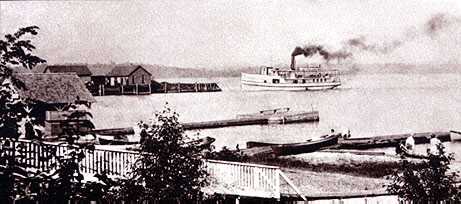
"LOU A. CUMMINGS" The question has been asked "Why, during the last quarter of the nineteenth century, were there so many steamships running regular schedules from here to Harbor Springs and Petoskey, Boyne City and East Jordan?" The answer is to be found in the fact that most of the towns located close by were served by railroads, while Charlevoix was not. In semi-isolation from the rest of the world except by water and footpaths, the little community was almost completely dependent upon boats for transportation. Then why was Charlevoix the last to be served by railway? For strictly economic reasons. Roads were practically an immediate necessity for the interior, for towns had to be served. Railroads were the easiest solution. Roads as we know them today were non-existent. Those that were in use were dirt or cordoroy, not much use in long travel. Since Charlevoix was accessible by water, the greater need must be for those towns of the interior. The Grand Rapids and Indiana (G. R.& I.) served Boyne Falls, Petoskey, & Harbor Springs. East Jordan actually had two railroads. One was the D. & C. (Detroit & Cleveland), and the other was the E. J.& S. (East Jordan & Southern). One had a terminal depot in EAST Jordan, and one a terminal in WEST Jordan. It was planned to extend one of the lines to Charlevoix, but was halted soon after the roadbed had been laid shortly this side of Ironton. (News of the new line from Traverse City to Charlevoix cancelled out the plan.) As you drive down the hill going into Ironton from Charlevoix one can still see the ridge of the roadbed on the left. So almost everyone and everything came to Charlevoix in a boat, or left by boat. Not an unpleasant experience, but just a little slower and inconvenient.
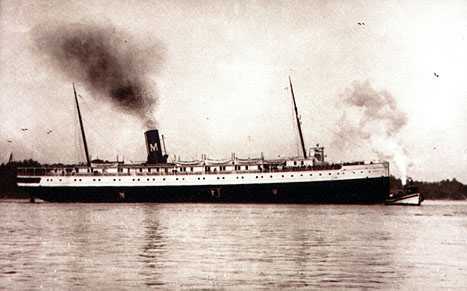
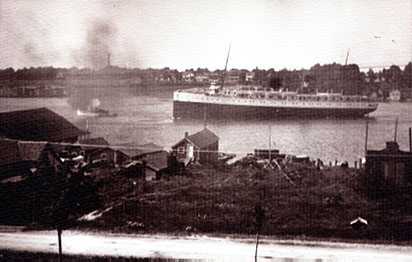
THE BIG TURN AROUND On her first trip to Charlevoix in 1896 the MANITOU was towed through the channel, turned around in the harbor, and jockeyed to her berth at Wilbur's dock by a tug. Up until that time she was the largest vessel to have entered and negotiated the difficult lower channel, with its elbow bend about 100 yards west ot the bridge. For a long ship it was a tricky business. It still is. Eventually Capt. Finucan was able to take the MANITOU through the channel, turn around in the harbor, and dock all without benefit of a tug. Occasionally a strong wind would make it hard to handle the big ships in Round Lake, so they would steam on into Lake Charlevoix, make the turn around there, then steam straight back to Wilbur's dock. With the fading of the sailing schooners from the scene and the growing independence of the large ships, towing as a business went into a sharp decline. Some tugs did part time fishing for a while, then turned to it totally and full time. These comprised the larger and newer tugs. Most of the older ones were simply retired.
THE MANITOU The S. S. MANITOU in Round Lake being turned around by a tug.
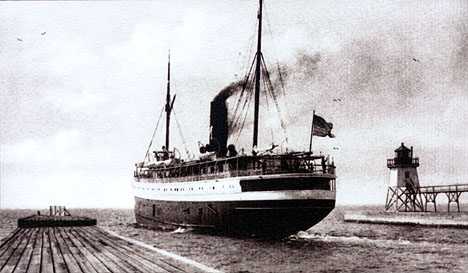
THE MANITOU The S. S. MANITOU leaving Charlevoix on her way to Chicago. |