|
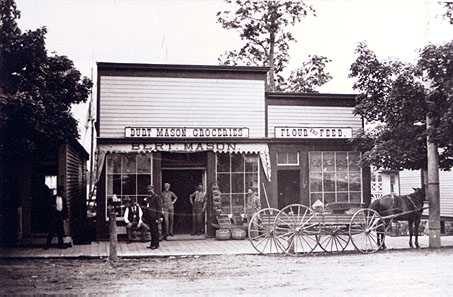
PROGRESSIVE MERCHANT OF THE NINETIES The above photograph shows the Bert Mason Grocery and Feed Store at 310 Bridge Street as it looked in the late nineties. To the far right can be seen the Bartlett Hotel, later the Charlevoix Hotel. An alley ran between the Hotel and the Grocery. On Saturday, when all the farmers came to town to do their shopping, they could drive down the alley to the back of the store where Mr. Mason had provided covered sheds for the horses, as well as a rear entrance to his store. A later photograph will show this same store after Bridge Street was paved and the boardwalks had been replaced by cement sidewalks, and the hitching posts eliminated. Note the schooner partly visible in the background.
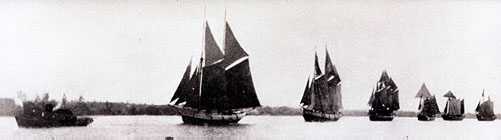
FRUITLESS VIGIL AT SOUTH POINT In the days of the lumber schooners, from about 1875 to 1910, the rivalry among tug captains was of such an intense nature that present day polite competition seems tame in comparison. Prerequisites for survival were quick ingenuity, a sharp wit, and the ability to interpret wild rumors correctly, rumors that were constantly floating around, some of them intentionally planted. The lack of rapid communication was a factor in the almost constant confusion, and gave time for stated facts to become wild rumored fancies. The big prizes in the towing business were the multiple tows, from two to six ships tied together in a long line. In the Charlevoix area there were only two tugs capable of handling multiple tows during the bustling Nineties. One was the "TAYLOR" and the other the "PARMELEE." The rivalry between these two tugs was well known, and the lengths to which each captain would go to win a towing job was the talk of the shipping industry on the great lakes. On one occasion a multiple tow of six ships was known to be on its way from the south and was due off Norwood on a Wednesday morning, so the preceding day the rivals made their tugs ready for the race to the schooners. Since it was well known that the "TAYLOR" was slightly faster than the "PARMELEE," the captain of the latter decided to get a good lead on his rival. So, the evening of Tuesday being calm, the "PARMELEE" slipped quietly out through the channel and cast anchor just beyond South Point. As night fell, the "TAYLOR" lay at her dock in Round Lake as though nothing had happened. It was a calm, moonless, dark and slightly misty sky, and the "PARMELEE" sat quietly at point, keeping a sharp watch of the piers for any sign of her rival. Shortly after midnight a sailing vessel was sighted leaving the channel. The lights on the spars and the lights fore and aft were clearly visible and were in sight for almost an hour before they slowly disappeared in the west. It was a pretty sight, and broke the monotony of the long watch. During the rest of the night there was nothing for the lookout to report. As morning approached, the captain of the "PARMELEE" began to get a little nervous, for it was past time for the "TAYLOR" to start her run. So he pulled anchor and headed southwest to meet the tow. The sun soon broke above the horizon, only to reveal in the distance, as in an unveiling, a long line of lumber schooners and one lone sailing vessel being towed by the "TAYLOR" slowly and silently toward the still sleeping village of Charlevoix. An impressive and majestic picture, one the captain of the "PARMELEE" would not soon forget.
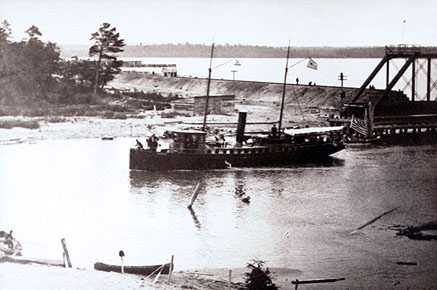
PLEASURE CRAFT A pleasure craft of the Nineties, name and owner unknown, passes the railway bridge in the upper channel.
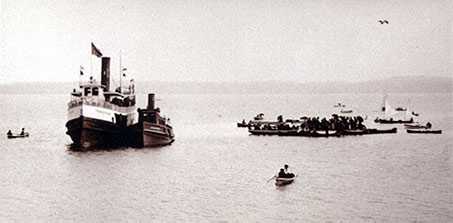
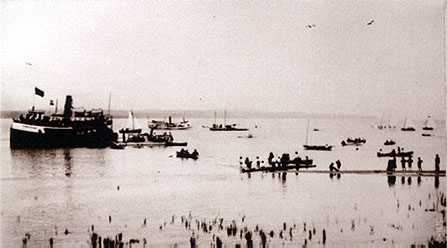
ANOTHER REGATTA ON PINE LAKE, 1898 Regattas were an annual affair, almost from the beginning of the resorts. There was much spirited competition, and these popular events were held into the late twenties. Shown above is the THOMAS FRIANT, which served as judge's boat for over ten years. Tied along side her is the tug MARTIN. A large raft was anchored close by, and for five cents one could have an excellent view of the races. The small ferry MINNIE S. can be seen alongside the raft.
|