|
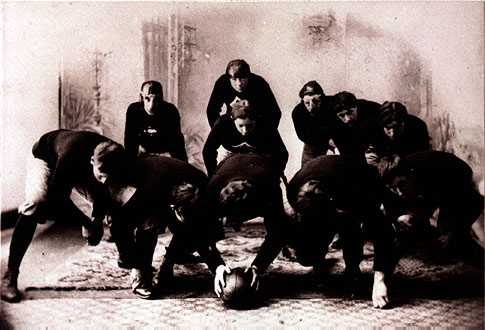
THE FLYING WEDGE In the earliest days of American Football it was just that, FOOT ball, a direct product of Rugby. A player could either run with the ball or kick it, and only when a player carried the ball could he be tackled. In the evolution of the game in America, almost from the beginning, the kick as a means of gaining ground gave way to running with the ball. Bodily contact appealed to the youth of that day. Soon kicking was used only for the punt, or the ball was drop-kicked to score. Rules were few, and what changes were made in the rules were inadequate for the rapidly changing game. In the Nineties the game deteriorated from wide open play into concentrated and close bodily contact, into what some called Mass Mayhem. Out of this developed what was called THE FLYING WEDGE, in which the linesmen locked arms, put shoulder to rump, or fused as one unit in any way they could. When a play was executed the center took the brunt of the shock. The wedge was supposed to open a wide hole, with the ball carrier following in the wings of the wedge. It worked fine for those who first used it, but injuries and even deaths were so numerous on the gridiron that a public outcry caused the whole concept of THE FLYING WEDGE to be outlawed forever. Pictured above is the Charlevoix team of 1901 demonstrating the formation called THE FLYING WEDGE.
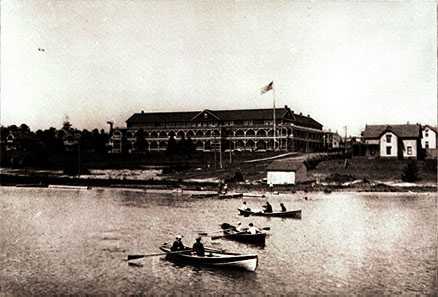
THE BELVEDERE HOTEL With the coming of the railroad in 1892 and the opening of THE INN in 1898 the Charlevoix resort business grew by leaps and bounds. The Belvedere members found that the NEW BELVEDERE HOUSE could not take care of the rapidly growing influx of summer visitors. In 1902 the hotel was greatly enlarged and extensive improvements were made, at a cost of $25,000.
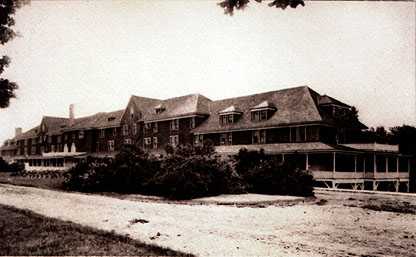
THE INN - WEST SIDE
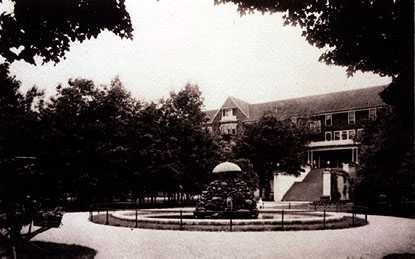
THE INN - EAST ENTRANCE
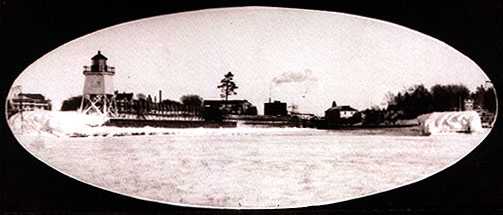
WEST ENTRANCE TO THE LOWER CHANNEL This unusual winter scene, taken in 1904, shows, from left to right, the Beach Hotel, the lighthouse on the north pier, the stack of the lumber mill, the Fountain City House, the Roller Mill, the Swing bridge, the Lewis Grand Opera House, the ice covered south pier, and the Life Saving Station. |